


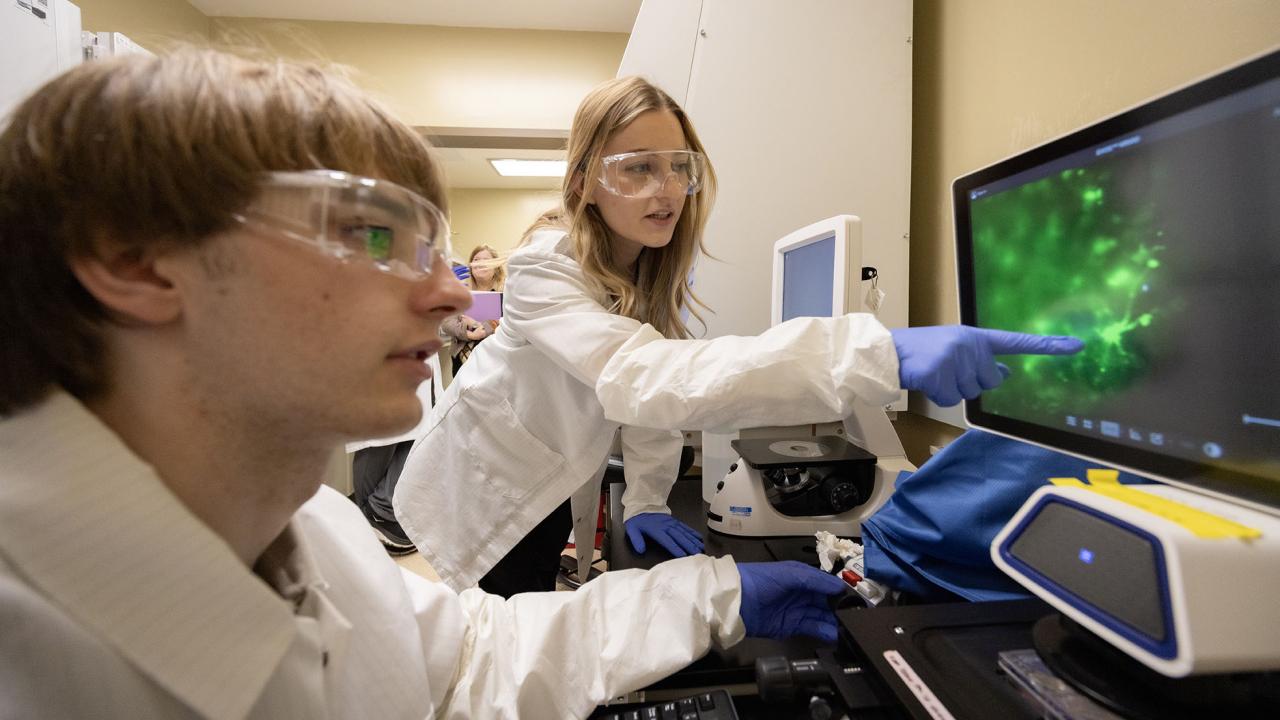
Developing Apps to Investigate Neurological Disorders
How one UC Davis student imagined systems to accelerate lab breakthroughs
Iliya Voytsyshyn, a fourth-year systems and synthetic biology major from Ukraine, entered UC Davis with plans to study cancer. That initial goal grew into a fascination with tools that fuse biology, systems design and gene editing to re-engineer cells.
Voytsyshyn chose UC Davis because the campus offered early access to labs and hands-on undergraduate research. Interest in cancer cells that divide indefinitely versus normal cells that die off led him to volunteer in campus labs that study these questions — first the Xu Lab, then the Fink Lab at UC Davis Health.
“I knew UC Davis had a large faculty, a renowned animal science program and a strong marine institute,” Voytsyshyn said. “My focus later shifted toward molecular biology and gene editing, and right now, I learn how to design and plan complex projects, master experimental testing and bridge the gap between computational approaches and wet-lab bench science. But my original goal remains — I draw inspiration from nature, such as bacteria, and use it to develop, adapt and modify novel biomolecular tools.”

Jumping into the lab
Voytsyshyn joined the Xu Lab, led by principal investigator Lifeng Xu, associate professor of microbiology and molecular genetics, as a first-year student. There, he sought deeper insight into how cancer cells survive and thrive while other cell types die more quickly. He then developed tools that quantify this work and created his first app in the Xu Lab.
“Iliya consistently sought the ‘why’ behind each method,” Xu said. “That intellectual drive helped him progress quickly from a motivated student to a sophisticated research tool developer.”
Voytsyshyn pursued deeper insight into genetic conditions and their impact on cells and secured another opportunity in the Fink Lab with Kyle Fink, associate director of the Gene Therapy Center and associate professor in the Department of Neurology. The lab operates within the Institute for Regenerative Cures at UC Davis Health.
“Iliya immediately contributed to several lab projects, but most critically, helped solve a long-standing problem our research group was facing. He combined his previous research experiences and coursework to develop a novel tool that has greatly accelerated our research endeavors and helped streamline our data analysis,” Fink said. “I am super proud to have mentored Iliya in the lab and look forward to the contributions he will continue to make in his career.”
At the Fink Lab, Voytsyshyn collaborates closely with Klaudia Braczyk, a doctoral student in the Integrative Genetics and Genomics Graduate Group. Braczyk credited his significant contributions to her own research and plans to name him second author in a proposed journal article.

Developing an app
Voytsyshyn’s app advances understanding of healthy versus diseased cells. The app produces quantifiable data that helps scientists propose new treatment regimens so girls with Rett syndrome receive care sooner and avoid severe neurological complications. Rett Syndrome is a rare neurological disorder caused by genetic mutations that disrupt brain development, usually affecting girls.
Researchers build 3D lab-grown miniature brain models, known as brain organoids, and analyze gene function in both healthy and faulty cells. Through this, the lab aims to learn more about the disease itself and test potential therapeutics that aim to reduce disruptions in neurons and restore correct brain cell functions
Connie Champagne, executive director of education, training and workforce development for the UC Davis Comprehensive Cancer Center, described Voytsyshyn’s approach in the lab as innovative.
“Where others see problems, Iliya sees opportunities and pursues creative solutions,” Champagne said. “He excels at computational approaches that increase research efficiency.”

Opportunities at UC Davis and beyond
Voytsyshyn pursued research labs that aligned with his career goals and gained hands-on experience alongside graduate students and faculty researchers.
He presented at the 2025 UC Davis Undergraduate Research, Scholarship and Creative Activities Conference on research conducted at the Xu Lab, earned second-author credit on a Fink journal article and this spring he travels to the American Society of Cell and Gene Therapy annual meeting to share findings.
He plans to pursue a doctorate in these fields and aims to develop new research models, conduct translational bench research, lead his own lab and mentor future researchers.
“UC Davis provided access to research experiences that students at other colleges seldom receive,” Voytsyshyn said. “My coursework, combined with lab work on the Davis campus and at UC Davis Health, prepared me well for my next career steps.”
Media Resources
- This story appeared originally on the UC Davis Enrollment Management website.