



Whale Tale: How the UC Davis Beaked Whale Found its Way to Campus
Long ago, on a faraway Aleutian island, a pair of rare beaked whales got stranded. One was saved by biologists and swam back out to sea. The other perished and its skeleton now hangs inland, thousands of miles from home.
The story might sound a little like the start of a children’s book, but it’s true—and students and visitors to UC Davis can find proof any time they walk into Storer Hall. The whale’s skeleton has hung in the building’s atrium for more than 40 years, thanks to Ed West (’80), who earned his Ph.D. from the zoology department (today, the Department of Evolution and Ecology), and is now the CEO of West Ecosystems Analysis in Davis.
Nobody at UC Davis was expecting a whale skeleton, but thanks to the intrepid spirits of Ed and his wife Kathy, who earned her master’s degree at UC Davis in primate ecology (BS ’79, MS ’82) and is now a wildlife conservation photographer, that’s what they got.
A Prize Specimen

Soon after completing his Ph.D., West—whose doctoral research was on the behavioral ecology of pikas in the Sierra Nevada—headed to Alaska for a postdoctoral research project with the US Fish and Wildlife Service and his friend and fellow UC Davis zoology Ph.D. Ron Garrett. The project aimed to develop field methods to remove Arctic foxes, an invasive species introduced by Russian fur traders, from the Aleutian Islands, where they were devastating sea bird populations.
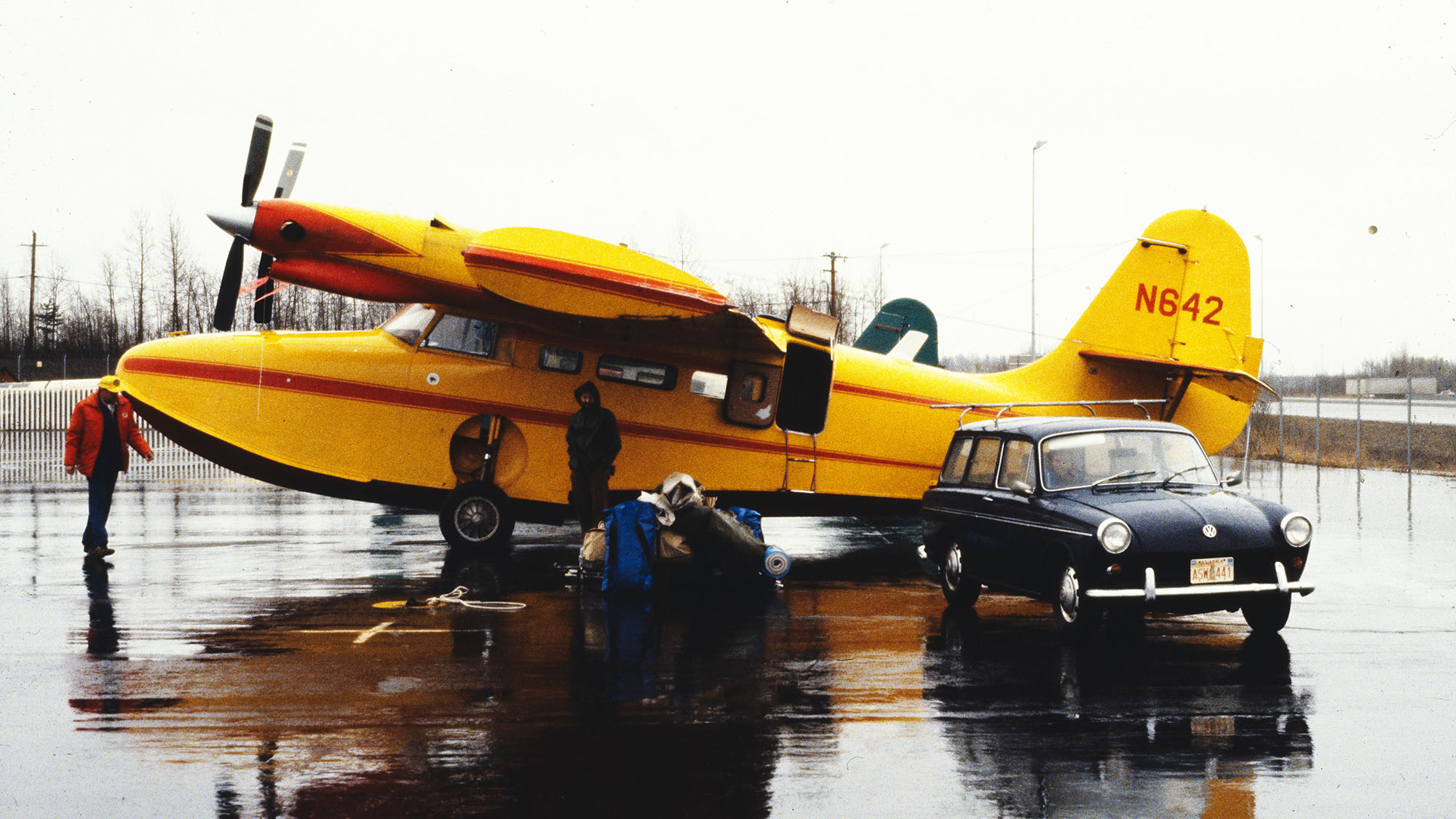
The Wests were newlyweds, and Kathy, Ed’s principal field research associate, joined her new husband in Anchorage just days after finishing her own research on the behavorial ecology of siamangs (a type of gibbon) in Sumatra. The couple embarked on their enterprise by traveling 1200 miles via seaplane to Adak Island—a flight that turned into quite an adventure. A volcanic eruption in Russia had filled the air with ash, and all commercial flights were canceled. “Our seaplane pilot was a seasoned Alaskan bush pilot, and he said, ‘We’re still going’”—but it could only be done by flying under the ash and cloud layer, which hung at a mere 300 feet. “The entire flight was chartered low over the water, with close fly-bys of many volcanic islands,” West recalled. “It was truly amazing.”
The Wests built a remote field camp on the island of Kagalaska, where they radio collared and studied the behavior of the foxes. Their base camp was on nearby Adak Island, then home to both a Navy base and a Fish and Wildlife Service headquarters. “One morning we got a call,” said West. “Fish and Wildlife said there was a Stejneger’s beaked whale beached right in front of their office in a cove. And it was still alive.”
Beaked whales are relatively small, elusive, and rarely spotted at sea; this one was stranded on rocks. After a first careful attempt to free it, it returned to the rocks; ultimately, a Fish and Wildlife employee guided the whale to sea by swimming far out in the cove, holding its dorsal fin. “Because it was obviously stressed and had been stranded, we were concerned it might beach itself again, so we put out the word to the Navy and the Marines to keep a lookout for it around the island,” West said.
A few hours later, the Marines called: there was a beached whale on the opposite side of the island. It turned out to be a different, slightly larger whale, which had not survived. “It had just recently died, and it washed up on the sandy beach,” said West. “I could not resist. It was this prize specimen.”

From Alaska to Zoology
With permission from the Fish and Wildlife Service, West called his mentor at UC Davis, Milton Hildebrand—a professor of zoology who died in 2020—to offer him the skeleton. “It was a good thing the whale was on Adak, because the Marines helped. We had to roll it up onto the beach above high water, and that took some straps and a couple of vehicles,” he recalled.
Ed and Kathy West then got to work. “We spent maybe a day and a half dissecting it on the beach,” he said. “It’s a very simple skeleton, but we had to be careful to get all the digits on the flippers. Then we put all the pieces in cardboard boxes and got permission to transport them to a secure area guarded by Marines, where it wouldn’t be disturbed.” (They left the whale flesh on the beach, where it didn’t go to waste: Arctic foxes devoured it overnight.)
Preparing the skeleton on the remote island took some ingenuity. First, to help degrade the tissue on the bones, West left them out in the rain for “a month or two,” he said. “Then we got big metal garbage cans, and put them on Coleman stoves, filled them with water, and then put the bones in, and boiled them to take the tissue off.”
Next, they scraped the bones, labeled and numbered each one, boxed them up, and shipped them to Hildebrand in Davis. Surprisingly, the shipment only weighed 35 pounds, West says.
In Davis, Hildebrand studied the skeleton, determining that it had been a small female, and further cleaned and assembled it. “Dr. Hildebrand had a good time with that,” said West. “All the pieces were in order, but I didn’t get all the small bones off one of the flippers, so he had to simulate a missing digit.”
The department celebrated the small whale’s move to Davis with a “whale-raising” in September 1982. Ever since, the painstakingly reassembled skeleton has presided serenely over Storer Hall’s hustle and bustle. It has become a mascot of sorts, donning seasonally changing accoutrements, from a jaunty witch hat in October to a graduation cap each June—although who adorns the whale, and how they do it, is “a little EVE mystery,” said Shelley Williams, a staff member in the Department of Evolution and Ecology.
Despite the whale’s prominence, it has remained nameless in all these decades. West suggests that an appropriate sobriquet, in honor of his mentor Hildebrand, would be “Hilde.”

Media Resources
- Kate Washington, Ph.D., is a freelance writer based in Sacramento and the author of Already Toast: Caregiving and Burnout in America. Her work has appeared in the New York Times, TIME and Sunset, among other publications.