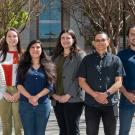
Two students from the College of Biological Sciences have been awarded the UC President's Pre-Professoriate Fellowship. The highly competitive fellowship supports professional development in exceptional Ph.D. candidates who are alumni of California-based Hispanic Serving Institutions as part of the UC-Hispanic Serving Institutions Doctoral Diversity Initiative.
Four faculty, two each in CBS departments and graduate groups, are among this year’s recipients of the Academic Senate and Federation top awards. They are in a cohort of 15 academics across various disciplines throughout the university to be recognized.
The awards cite the impact these academics have had on their fields, on UC Davis students and on the broader community through public service.
Two College of Biological Sciences faculty members—Keith Baar, professor of neurobiology, physiology and behavior, and Laura Bogar, assistant professor of plant biology—received a STAIR Grant and a Hellman Fellowship, respectively.
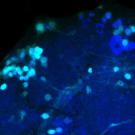
A new study by the University of California, Davis, shows how cells work together to avoid a sudden drop in blood sugar. Understanding these feedback loops could improve the lives of people with diabetes and help them avoid dangerous hypoglycemia.
The work was published Sept. 16 in Proceedings of the National Academy of Sciences.
The mind of a fruit fly encompasses 125,000 nerve cells, squeezed into the space of a poppy seed. At first glance, the fly brain looks nothing like a human brain. But many of the underlying neural circuits are surprisingly similar.
Fumika Hamada, a professor of neurobiology, physiology, and behavior, is using fruit flies to study a critical but oft-overlooked brain function: the regulation of our body temperature in a consistent daily rhythm.
Although teaching is a core part of being a professor, most academics learn how to teach on the job. CBS’s Future Undergraduate Science Educators (FUSE) program is changing that.
Faculty members in the College of Biological Sciences (CBS) and graduate student teaching assistants who support CBS undergraduates have been named Aggie Well-Being Champions. The new award recognizes instructors who prioritize students’ well-being and cultivate spaces where undergraduates can thrive.
Three faculty affiliated with the College of Biological Sciences are among the eight UC Davis faculty newly elected as fellows of the American Association for the Advancement of Science, announced March 27. They are: Frédéric Chédin, a professor and chair in the Department of Molecular and Cellular Biology; Dario Cantù, a professor in the Department of Viticulture and Enology; and Huaijun Zhou, a professor in the Department of Animal Science.
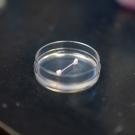
Exercise physiologist Keith Baar specializes in sports medicine. He studies the effects of exercise on bone, muscle and tendon health.
In this Q&A, he discusses how intensive exercising after injury or when overweight can cause damage to ligaments and tendons. He also talks about the importance of integrating isometric or static exercises into our fitness routines.