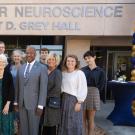
The main building of the Center for Neuroscience (CNS) has a new name: “Robert D. Grey Hall” in honor of Robert D. Grey, Provost and Executive Vice Chancellor Emeritus, who served UC Davis and the University of California system for 37 years. The building dedication ceremony was held October 11, 2023.
These questions, among others, occupy the mind of Charan Ranganath, a UC Davis psychology professor in the UC Davis College of Letters and Science and a core faculty member with the Center for Neuroscience. But the transient nature of memory isn’t just a focal point of Ranganath’s research. It’s something that he, like the rest of us, deals with daily.
“As a memory researcher, the most common question that I get in my everyday life is, ‘Why am I so forgetful?’” Ranganath said.
A new study shows how the brains of Egyptian fruit bats are highly specialized for echolocation and flight, with motor areas of the cerebral cortex that are dedicated to sonar production and wing control. The work by researchers at the University of California, Davis, and UC Berkeley was published May 25 in Current Biology.
The Center for Neuroscience recently announced two new funds, the Karen Sigvardt, Ph.D. Neuroscience Award and the Karen Sigvardt, Ph.D. Neuroscience Fellowship.
The award and fellowship were established in October 2021 and endowed through a generous gift from Audrey Webb, in loving memory of her late partner Karen Sigvardt, Ph.D., Professor Emeritus of Neurology in the School of Medicine and a valued core member of the Center for Neuroscience and the greater neuroscience community at UC Davis.
Last month, the University of California, Davis, officially launched a consortium called the UC Davis Neuroscience Consortium (UCDNC) to leverage the strength, breadth and depth of one of the largest neuroscience communities in the world. The consortium brings together nearly 300 researchers from eleven centers and 41 departments — integrating biologists, chemists, social scientists, engineers, computer scientists and clinicians.
People love stories. We find it easier to remember events when they are part of an overarching narrative. But in real life, the chapters of a story don’t follow smoothly one from another. Other things happen in between. A new brain imaging study from the Center for Neuroscience at the University of California, Davis, shows that the hippocampus is the brain’s storyteller, connecting separate, distant events into a single narrative. The work is published Sept. 29 in Current Biology.
Opioids are powerful painkillers but their use is hindered because patients become tolerant to them, requiring higher and higher doses, and overdoses can cause respiratory depression and death. A recent study from researchers at the UC Davis Center for Neuroscience contradicts existing thinking about how opioid drugs cause tolerance and respiratory depression, and suggests a new, balanced approach to developing safer analgesics. The work was published July 13 in Neuropsychopharmacology.
The University of California, Davis, today named the recipients of the 2021 Chancellor’s Innovation Awards. The awards recognize faculty, project teams and community partners for their work, dedication and success in improving the lives of others and addressing the needs of our global society through innovative solutions. David E.
The National Institute of Mental Health (NIMH) has awarded a $15.7 million grant to the UC DavisSilvio O. Conte Center, one of only 15 Conte Centers nationwide.
Psychiatric illnesses and neurodevelopmental disorders, including schizophrenia, affect 15-20 percent of the population worldwide, yet current treatments are at best only partially effective. The UC Davis Conte Center was first established in 2016 through the Center for Neuroscience to determine how maternal infection increases risk for these disorders and to identify new targets for novel treatments.
Studies with laboratory mice at the UC Davis Center for Neuroscience show how activation of the mother’s immune system during pregnancy can lead to neurological problems in offspring. Researchers have now found a way to detect which mice are susceptible to this effect