Plants need to be able to communicate with themselves—by sending signals from their leaves to their roots to their flowers—so that they can coordinate growth and optimize resource use. They also need to communicate with other plants and organisms, which they achieve by releasing volatile organic compounds (VOCs), tiny molecules that are often associated with distinct smells. Scientists know a lot about how plants emit these odorous signals, however very little is known about how they receive and interpret them.
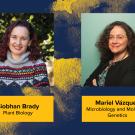
Ten faculty from UC Davis are among 502 newly elected fellows of the American Association for the Advancement of Science, the society announced today (April 18). AAAS fellows are scientists, engineers and innovators who have been recognized for their achievements in science, including research, teaching, administration and science communication.
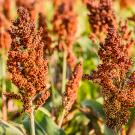
Sorghum, or broomcorn, is a staple crop in sub-Saharan Africa, but approximately 20% of annual yields are lost due to infections with witchweed (Striga hermonthica), a parasitic plant that steals nutrients and water by latching onto the plant’s roots.
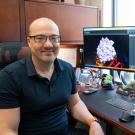
Distinguished Professor Walter Leal has made history as the first UC Davis faculty member to be honored by the Academic Senate with all three of its awards, which celebrate outstanding teaching, public service and research.
In 2020, the Academic Senate awarded Leal the Distinguished Teaching Award for undergraduate teaching, and in 2022 Distinguished Scholarly Public Service Award. Known internationally for his groundbreaking work in insect olfaction and chemical ecology, Leal's achievements have now earned him the 2024 Faculty Distinguished Research Award.
A promising new fungicide to fight devastating crop diseases has been identified by researchers at the University of California, Davis. The chemical, ebselen, prevented fungal infections in apples, grapes, strawberries, tomatoes and roses, and improved symptoms of pre-existing fungal infection in rice.
Funding agencies and universities should make it more equitable for early-career investigators with non-traditional career paths to compete for grants and progress in their careers, argue four scholars with non-traditional backgrounds in a paper published in PLOS Biology in the fall of 2023.
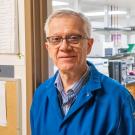
Jeffrey Ross-Ibarra, a professor in the Department of Evolution and Ecology at the University of California, Davis, has been awarded the prestigious National Academy of Science Prize in Food and Agriculture Sciences for 2024. Ross-Ibarra was awarded the prize in recognition of his “pioneering studies on the evolutionary genetics of maize, a key crop species for global food production.”
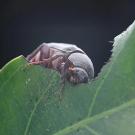
Life on Earth runs on a 24-hour cycle as the planet turns. Animals and plants have built-in circadian clocks that synchronize metabolism and behavior to this daily cycle. But one beetle is out of sync with the rest of nature.
Plants have to be flexible to survive environmental changes, and the adaptive methods they deploy must often be as changeable as the shifts in climate and condition to which they adapt. To cope with drought, plant roots produce a water-repellent polymer called suberin that blocks water from flowing up towards the leaves, where it would quickly evaporate. Without suberin, the resulting water loss would be like leaving the tap running.
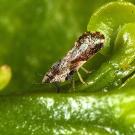
A failed field test has led to a major discovery about the Asian citrus psyllid, the insect that spreads the devastating citrus greening disease. According to new research, the bacteria that cause citrus greening can interfere with the insect’s sense of smell, rendering some kinds of insect traps useless. The work is currently available as a preprint.