Research Stories

Student-Led Research Reveals “Off-Switch” for Autophagy

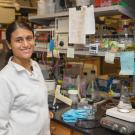
A chance observation in an undergraduate laboratory class has shed light on a key cleaning and recycling process carried out by all eukaryotic cells. Autophagy breaks down organelles, proteins and other molecules so their components can be reused and plays a protective role in preventing disease. However, when autophagy doesn’t work correctly, it’s associated with cancer and neurodegenerative diseases including Alzheimer’s. Previous research has uncovered how cells activate autophagy, but little is known about how it is switched off.

Discovery Hints at Genetic Basis for the Most Challenging Symptoms of Schizophrenia

Our understanding of schizophrenia has increased greatly in recent years, as studies of large groups of people have identified a multitude of genetic variants that increase a person’s risk of the disease. But each of those individual risk factors accounts for “only a very minor amount of the overall risk,” said Alex Nord, a professor of neurobiology, physiology and behavior in the College of Biological Sciences and the Center for Neuroscience.

Plant Biologists Identify Promising New Fungicides

A promising new fungicide to fight devastating crop diseases has been identified by researchers at the University of California, Davis. The chemical, ebselen, prevented fungal infections in apples, grapes, strawberries, tomatoes and roses, and improved symptoms of pre-existing fungal infection in rice.

New Research Identifies Protein Integral to Sperm Development and Male Fertility

Early in the development of sperm, a strange event happens: the X and Y chromosomes condense into tight packages and are sequestered away from the other 44 human chromosomes. If any part of this process goes awry, the cells cannot mature into sperm. Researchers in the College of Biological Sciences have now identified an important link in this process — a little-known protein called ATF7IP2.

Postdoctoral Researcher Explores Regeneration in the "Reemerging" Hydra

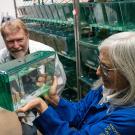
Ben Cox, a postdoctoral researcher in the lab of Celina Juliano, Department of Molecular and Cellular Biology, studies regeneration in Hydra vulgaris, a small cnidarian organism distantly related to the jellyfish. Cox is especially interested in tissue regeneration after injury and aims to determine how progenitor cells migrate and invade into injured tissues to restore lost cell populations, as well as how the extracellular matrix components are remodeled during this regeneration process.

Defects in DNA Packaging May Drive Age-Related Decline in Fertility

Yasuhisa Munakata, a postdoctoral fellow in the College of Biological Sciences, has received a grant to study how egg cells in the ovary change over time. “Our goal is to understand female reproductive aging, and why fertility rapidly declines starting in the mid-30s,” says Satoshi Namekawa, a professor of Microbiology and Molecular Genetics, in whose lab Munakata works.

New Findings Shed Light on Pancreatic Cancer Treatment Targets

Pancreatic cancer is the third leading cause of cancer-related deaths in the United States and only 12% of patients survive five years after being diagnosed. Severe pancreatic cancer is associated with metastasis, and it is this spread of secondary tumors that usually causes death, but little is known about the molecular mechanisms that drive metastasis.

Maize Researcher Wins Prestigious $100K National Academy of Science Prize

Jeffrey Ross-Ibarra, a professor in the Department of Evolution and Ecology at the University of California, Davis, has been awarded the prestigious National Academy of Science Prize in Food and Agriculture Sciences for 2024. Ross-Ibarra was awarded the prize in recognition of his “pioneering studies on the evolutionary genetics of maize, a key crop species for global food production.”