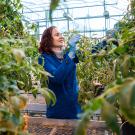
When it comes to plant rhythms, Stacey Harmer, a professor of plant biology at the University of California, Davis, is hip to the groove. Her research, which appeared in the August 5, 2016 journal of Science, describes how sunflowers track the sun, beginning each morning with their heads facing east, slowly swinging west throughout the day and then resetting eastward at night.
The College of Biological Sciences Faculty Teaching Award has two recipients for the 2016-2017 year. Luca Comai, professor of plant biology, and Michele Igo, professor and vice chair of microbiology and molecular genetics, are recognized for their excellence in teaching through enthusiasm and effectiveness of instruction, application of technology and innovation in the classroom, and mentorship and motivation of students.
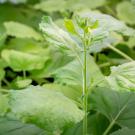
Professor Alan Rose has been working for over two decades to unravel a mechanism called “intron-mediated enhancement.” I’m a graduate student in Rose’s lab, and we made an exceptional discovery in an unexceptional plant called Arabidopsis thaliana, or thale cress.
Arabidopsis is the lab mouse of the plant world. The Rose lab uses this small weed to answer questions about the biology of all plants. In a study recently published in the journal The Plant Cell, we show that genetic material known as introns can play very dramatic roles in plants.
Two professors from the College of Biological Sciences have been recognized for their contributions to plant biology by the American Society of Plant Biologists.
“Throughout their careers, Professors Comai and Lagarias have conducted critical research that increased our ability to produce food and other important commercial crops,” said Mark Winey, dean of the College of Biological Sciences. “They have significantly contributed to food security for the people of the planet.”
Savithramma Dinesh-Kumar, a professor of plant biology and interim chair of the Department of Plant Biology at the University of California, Davis, has received the College of Biological Sciences 2015-2016 Faculty Research Award. He was recognized for his groundbreaking research in plant immunity and the role of chloroplast stromules in programmed cell death.
It’s summertime, and the fields of Yolo County are filled with ranks of sunflowers, dutifully watching the rising sun. At the nearby University of California, Davis, plant biologists have now discovered how sunflowers use their internal circadian clock, acting on growth hormones, to follow the sun during the day as they grow.
Chloroplasts, better known for taking care of photosynthesis in plant cells, play an unexpected role in responding to infections in plants, researchers at UC Davis and the University of Delaware have found.
Green shoots are a sign of spring, but growing those shoots and roots is a complicated process. Now researchers at UC Davis and the University of Massachusetts Amherst have for the first time described part of the network of genetic controls that allows a plant to grow.