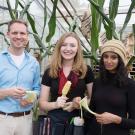
At the 57th Annual Meeting of the Phytochemical Society of North America (PSNA), Philipp Zerbe received the PSNA/Elsevier Young Investigator’s Award for his work.
For more than 20 years, curator Ellen Dean has made the Center for Plant Diversity a passion project. The center holds around 350,000 dried specimens, which tell tales from times long past.
In a new study, researchers found that the seemingly needless complexity of the plant circadian clock actually helps plants function in an array of environments.
In a study appearing in Cell Host & Microbe, UC Davis graduate student Neeraj Lal, Professors Savithramma Dinesh-Kumar and Andrew J Fisher and their colleagues reveal the versatility of plants’ molecular defenses. The findings provide a strategic map revealing how plants allocate resources and have the potential to help bolster crop immune systems and improve their development and growth.
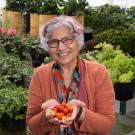
For her long-term contributions to the plant biology field, Sinha was recently honored by the American Society of Plant Biologists (ASPB) with a Fellow of ASPB Award, which recognizes distinguished members who have contributed to the society for at least 10 years.
In a paper appearing in PLOS Biology, Joseph Edwards, ’17 Ph.D. in Plant Biology, Professor Venkatesan Sundaresan, Departments of Plant Biology and Plant Sciences and their colleagues tracked root microbiome shifts throughout the life-cycle of rice (Oryza sativa). The research could help inform the design of agricultural probiotics by introducing age-appropriate microbes that promote traits like nutrient efficiency, strong roots and increased growth rates in rice plants.
They are prolific scholars, strong teachers, effective mentors and dedicated contributors to campus. This year, the College of Biological Sciences is pleased to announce that Associate Professor Siobhan Brady, Department of Plant Biology and the Genome Center, was named a Chancellor's Fellow.