In testing the genetic material of current populations in Africa and comparing against existing fossil evidence of early Homo sapiens populations there, researchers have uncovered a new model of human evolution — overturning previous beliefs that a single African population gave rise to all humans. The new research was published today, May 17, in the journal Nature.
“Do relatives make good neighbors?” UC Davis Distinguished Professor Emerita Sharon Strauss will answer this question and provide additional thoughts on species diversity in natural communities at the spring Emeriti Lecture in person and online on Monday, April 17, at 3pm.
Three UC Davis faculty members are among 125 recipients of this year’s Sloan Research Fellowships, prestigious awards given by the Alfred P. Sloan Foundation to early-career scientific researchers seen as emerging leaders in their fields.
The 2023 fellows, including UC Davis’ Kate L. Laskowski, Jesús M. Velázquez and Alexander S. Wein, “represent the most promising scientific researchers working today,” the Alfred P. Sloan Foundation said in announcing its selections Feb. 15.
From Chilean tidepools to the High Sierra, 12 UC Davis graduate students traveled the world this summer in search of answers to ecology’s most pressing questions.
In the blazing 100-degree Texas sun, Jon Aguiñaga waded through polluted waters on the side of freeways to capture tiny fish, which he then ran experiments on in the garage of an Airbnb. Marissa Sandoval flew to Florida to extract sexual-selection perfumes from the green inflorescent legs of orchid bees. MJ Farruggia trekked more than 1,000 miles in the Sierra backcountry for 240 days and is “still not tired of it.”
When you’re experimenting with water, electricity and live animals, a lot can go wrong if you’re not careful. And no one knows more about that than Rachael Bay and her research team.
They study human-induced changes in the environment and evolutionary processes — things like climate change, coral bleaching and bird migration. And when you’re doing that kind of work — handling chloroform one day and blood samples the next — you want to make sure you’re not cutting corners.
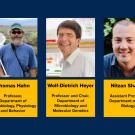
The college is very pleased to welcome the newest members of its broad and diverse faculty. With appointments in the Departments of Evolution and Ecology, Plant Biology and Microbiology and Molecular Genetics, the new faculty are poised to make an impact on their respective areas of expertise, and on the classroom and laboratory experience of our students across the college.
Anya Brown
Assistant Professor Department of Evolution and Ecology
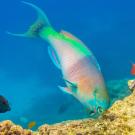
Coral reefs are home to a spectacular variety of fish. A new study by biologists at the University of California, Davis, shows that much of this diversity is driven by a relatively recent innovation among bony fish — feeding by biting prey from surfaces. The work was published the week of July 25 in Proceedings of the National Academy of Sciences.
With the close of the academic year just around the corner, many in the college are being recognized for the previous year’s accomplishments by campus units. With awards for undergraduate students, as well as postdocs and faculty, CBS was well-represented across campus award and honor ceremonies. The full list of recipients can be found on the respective award websites.
For the past two years, Population Biology Ph.D. Candidate Victoria Watson-Zink hasn’t solely spent her time at the UC Davis College of Biological Sciences studying the intricacies of land crab genetics. When she wasn’t in the lab, conducting fieldwork or teaching classes, Watson-Zink, a first-generation college student, dedicated her time to making the college a more welcoming and equitable place for its underrepresented students.