A global effort to map the genomes of all plants, animals, fungi and other eukaryotic life on Earth is entering a new phase as it moves from pilot projects to full-scale production sequencing. This new phase of The Earth BioGenome Project, or EBP, is marked with a collection of papers published this week (Jan. 17) in Proceedings of the National Academy of Sciences, describing the project’s goals, achievements to date and next steps.
University of California, Davis, evolutionary biologist Rachael Bay has been awarded a 2021 Packard Fellowship in Science and Engineering by the David and Lucile Packard Foundation. The fellowship offers Bay, assistant professor in the Department of Evolution and Ecology, College of Biological Sciences, an opportunity to advance her work on the role of human action on evolutionary trajectories of species.
The deep ocean is home to many strange looking fish and other animals. A new study shows that the cold, dark depths of the ocean contain a wider variety of body shapes for fish than shallower waters. That supports the idea that the deep ocean is a hotspot of evolution for fishes.
Two professors and an alumnus from the Center for Population Biology were among those elected to the National Academy of Sciences, as announced on Monday, April 26. “This is a thrill for the UC Davis community,” said Chancellor Gary May, who lauded the achievement of this year’s electees as one of the highest honors in the scientific community.
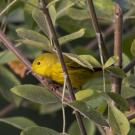
As climate change takes hold across the Americas, some areas will get wetter, and others will get hotter and drier. A new study of the yellow warbler, a widespread migratory songbird, shows that individuals have the same climatic preferences across their migratory range. The work is published Feb. 17 in Ecology Letters.
In a study appearing in Proceedings of the National Academy of Sciences, UC Davis researchers present a statistical method that—by virtue of providing a mathematical description of the relevant biological and technical processes associated with transcriptomic data—allows researchers to identify the expression state of genes.
Congratulations to Professor of Evolution and Ecology Sharon Strauss for winning the American Society of Naturalists’ Sewall Wright Award, which honors a senior and active investigator “promoting the conceptual unification of the biological sciences.”
The City Nature Challenge, a global event encouraging people to explore and record the natural world around them, returns to the Sacramento Region from April 24-27, albeit with a few changes due to the coronavirus pandemic.
Some species of fish, notably parrotfish and wrasses living on coral reefs, change their biological sex as they age, beginning life as females and later becoming functionally male. New work from the University of California, Davis, shows that this sequential hermaphroditism evolves when bigger males gain an advantage in reproductive success.
Recently, graduate students in Professor Eric Sanford's Scientific Filmmaking Seminar shared their films at the Ecology Film Festival. Now you can view all 11 films in one place.