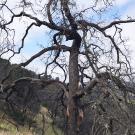
A new study from UC Davis researchers shows that when oak trees die, it triggers major changes to the community of soil microbes living beneath them. These changes have implications for soil health that could ripple out to impact entire ecosystems, especially given the recent rise in tree deaths due to droughts and wildfires.
Emery-Dreifuss muscular dystrophy (EDMD) is a devastating genetic disease that causes progressive muscle weakness and wasting. EDMD is caused by mutations in proteins within the nuclear envelope, yet the disease disrupts the organization and function of entire muscle cells. A new study by UC Davis researchers reveals one mechanism that may explain this connection.
The tiny aquatic hydra looks fragile at first glance, with tentacles that are slender and translucent. But if you cut it in half, each fragment regenerates into a complete new animal. Scientists studying this amazing feat have discovered a surprising detail: to trigger healing, specialized cells first have to invade the wound in a manner similar to what cancer cells do as they spread through the body.
To avoid self-pollination, avocado trees alternate between opening male and female flowers at different times of day. Some avocados are female in the morning and male in the afternoon, while others are on the opposite schedule. How avocados do this has been unclear — until now.
The mountain jewelflower inhabits a wide swath of California and Oregon, from summer-scorched foothills to high mountains where snow falls during winter. But it is already suffering from climate change, with plants in the mountains struggling to survive both summers and winters, according to a study from the University of California, Davis.
A nerve cell resembles a vast tree with branches that communicate with thousands of other cells. To function, it depends on a motor protein that walks on two legs, hauling urgent cargo from the center of the cell to the faraway tips of every branch. Scientists have unveiled a new structure of this walking protein, showing how cells control it.
Cancer cells are quick to develop resistance to anti-tumor drugs. New research by scientists from the University of California, Davis shows how cancers adapt to evade a class of anti-tumor drugs called BET inhibitors and offers hope for more effective therapies.
As wildflowers go, the mountain jewelflower is demure, clever and quietly unbreakable. It has spread across many of California’s iconic landscapes, from Sonoma wine country to the oak-dotted foothills, even over the Sierra Crest, where snow covers the ground during winter.
The causes of male infertility can be hard to diagnose, with many tests failing to detect genetic defects. Sometimes, infertility doesn’t even involve the genes themselves. It can arise from improper folding of the father’s DNA in the sperm. If a couple conceives, this mispackaged DNA can damage the lifelong health of the child.
A kestrel swoops to grab a smaller bird on the wing and eats it, right in front of a group of men in the garden at California Health Care Facility, or CHCF, a prison in Stockton, where the garden has become both a thriving ecosystem and a science classroom for people incarcerated there. As the feathers fly, UC Davis researcher Laci Gerhart pulls out a bird guide and shows the incarcerated men how to identify the bird by its size and coloration, noting that kestrels are North America’s smallest raptor and one of the few that are sexually dimorphic.